Prairie Light Press Reader Preview of:
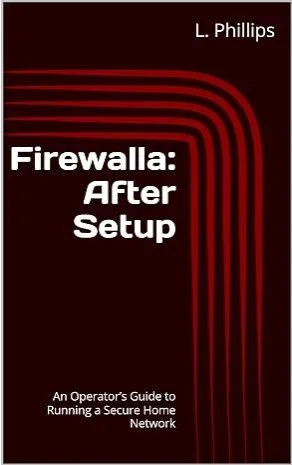
Firewalla: After Setup
An Operator’s Guide to Running a Secure Home Ntework
Preview
Firewalla: After Setup
An Operator’s Guide to Running a Secure Home Network
The following pages are an exclusive preview of Firewalla: After Setup: An Operator’s Guide to Running a Secure Home Network
Exclusive Preview from Prairie Light Press
Firewalla: After Setup
An Operator’s Guide to Running a Secure Home Network
Table of Contents
INTRODUCTION — BEYOND BASIC SETUP...................................... 9
CHAPTER 1 DEVICE DISCOVERY & IDENTIFICATION.................. 12
CHAPTER 2 NAMING CONVENTIONS THAT SCALE...................... 17
CHAPTER 3 GROUPING STRATEGY................................................... 20
CHAPTER 4 BUILT-IN PROTECTIONS................................................ 24
CHAPTER 5 ONE-WAY COMMUNICATION RULES.......................... 32
CHAPTER 6 BLOCKING LATERAL MOVEMENT.............................. 39
CHAPTER 7 REGION & COUNTRY BLOCKING................................ 47
CHAPTER 8 OPERATIONAL AWARENESS & ONGOING MAINTENANCE 53
CHAPTER 9 THE SUSTAINABLE OPERATOR MODEL.................... 59
Get Started Right Away with our Quick-Start Guide on page 5
QUICK-START FOR OPERATORS (90MINUTES)
This book is designed to be read end-to-end, but you don’t need to do everything at once.
If you have about 90 minutes, this section gives you the highest-security return for your time. You can come back later for depth.
0–10 MINUTES: CLARITY
· Read Chapter 1 to adopt the operator mindset
· Skim Chapter 2 to understand device discovery
· Ensure most devices are identified and named (perfection not required)
Goal: You know what’s on your network and why.
10–30 MINUTES: STRUCTURE
· Read Chapter 3 (Naming Conventions)
· Read Chapter 4 (Grouping Strategy)
Apply immediately:
· Use a consistent naming convention
· Create at least Trusted, IoT, and Guest groups
· Assign every device to a group
Goal: You can reason about your network at a system level.
30–45 MINUTES: BASELINE PROTECTION
· Read Chapter 5 (Built-In Protections)Enable:
· Active Protect (Default mode)
· Ad Block (network-wide or IoT-only)
Goal: To remove ambient risk without ongoing effort.
45–70 MINUTES: CONTAINMENT
· Read Chapter 6 (One-Way Communication)
· Read Chapter 7 (Blocking Lateral Movement)
Apply:
· Block IoT devices from initiating connections to local networks
· Block IoT-to-IoT communication
Goal: Prevent small compromises from spreading.
70–90 MINUTES: EXPOSURE REDUCTION & HABITS
· Skim Chapter 8 (Region & Country Blocking)
· Read Chapter 9 (Operational Awareness)
Apply:
· Add conservative geo-blocking for IoT or Guest groups
· Establish a simple weekly review habit
Goal: Reduce noise and make problems obvious.
WHAT TO SKIP FOR NOW
· Fine-grained exceptions
· Advanced tuning
· Edge-case optimizations
Those come later, once the system is stable.
QUICK-START TAKEAWAY
If you complete this path, your network will be:
· Structured
· Contained
· Quiet
· Sustainable
You can now read the rest of the book for depth instead of urgency.
NOTE TO READER
This edition has been refined for clarity, pacing, and long-term usability.
No concepts were simplified. No security posture was weakened.
You’ll notice:
· Cleaner sectioning for scan-reading
· Consistent terminology and tone
· Priority callouts where decision overload is common
· Operator Takeaways that reinforce judgment, not checklists
This is an operational manual. Read actively.
Disclaimer
This book provides general guidance based on common home-network environments and typical Firewalla configurations. Every network is different.
You are responsible for understanding your own environment, testing changes incrementally, and adjusting rules to fit your specific needs.
No security configuration is risk-free, and no guidance replaces informed judgment.
INTRODUCTION — BEYOND BASIC SETUP
So you’ve got Firewalla installed. It’s running. The lights are blinking. Devices are connecting. Internet works.
Congratulations—you’ve completed the easy part.
Now comes the real work: actually using Firewalla effectively. This is where most people struggle. Not because Firewalla is difficult, but because network management requires ongoing attention, decision‑making, and refinement. It’s not a set‑it‑and‑forget‑it appliance.
This book is about that operational phase—the weeks, months, and years after setup. It’s about the daily decisions, the maintenance routines, and the judgment calls that determine whether Firewalla becomes an essential security tool or just another box gathering dust.
WHAT THIS BOOK IS (AND ISN’T)
This is not a setup guide. We assume Firewalla is already running in Router Mode with devices connected. Installation, onboarding, and feature tours are deliberately excluded.
This is an operational manual.
Specifically, this book focuses on:
· Making naming decisions that scale
· Organizing devices for long‑term management
· Creating rules that survive real‑world use
· Recognizing what is normal vs what deserves attention
· Building habits that keep your network secure without constant babysitting
Think of it this way: the setup guide gave you a working car. This book teaches you how to drive it well, maintain it properly, and avoid common accidents.
WHO THIS BOOK IS FOR
You’re the intended reader if:
Firewalla is installed and working
· Your device list is cluttered or confusing
· You ignore most alarms because there are too many
· You’ve created rules that don’t seem to help
· You want better security but aren’t sure what to do
You’ll get the most value if you’re willing to invest a few focused hours up front. Organization and clarity reduce ongoing effort dramatically.
THE OPERATIONAL MINDSET
Effective network management requires a mindset shift.
Think in systems, not one‑off fixes. When something goes wrong, ask whether it represents a pattern that deserves a structural response.
Embrace iteration. Your configuration will evolve. That’s normal.
Balance security and usability. Over‑restriction leads to workarounds that undermine security entirely.
Invest time early to save time later. Naming and grouping may feel tedious, but they pay dividends forever.
Document decisions. Future‑you will not remember why a rule exists.
Identification works best as a loop. Observe first, name devices once you’re confident, and revisit periodically as behavior and inventory change.
OPERATOR TAKEAWAYS
· Firewalla effectiveness depends on how it’s operated, not how it’s installed
· This book is about judgment, habits, and systems—not features
· You’re adopting an operator mindset, not a consumer mindset
NEXT: We stop guessing and start identifying what’s actually on your network.
CHAPTER 1 DEVICE DISCOVERY & IDENTIFICATION
Before you can secure your network, you need to know what’s on it.
Most networks begin in partial ignorance: dozens of devices, many unnamed, some unknown. This chapter turns that uncertainty into inventory.
IDENTIFICATION IS A PROCESS, NOT A TASK
Device discovery is not something you finish once. New devices appear. Old ones disappear. Patterns emerge over time.
Treat identification as an investigative process rather than a cleanup chore. This mindset prevents frustration and encourages iteration.
Enable Active Protect first, then turn on Ad Block. Family Protect can be added later once structure and visibility are stable.
IF YOU ONLY DO ONE THING
Identify and correctly name at least 90% of your devices.
A mostly‑labeled network is exponentially more manageable than a perfect one that never gets finished.
HOW TO: Access Your Device List
1. Open the Firewalla app
2. Tap 'Devices' in bottom navigation
3. Tap arrows icon (top right) for View Options
4. Use search bar to find devices
HOW TO: Identify Unknown Devices
STEP 1: Check Basic Information
1. Tap device
2. Review Manufacturer, Hostname, MAC
STEP 2: Analyze Network Activity
1. Check Network Flows
2. See what services device connects to
STEP 3: MAC Lookup
1. Visit MAC lookup website
2. Enter first 6 characters
STEP 4: Elimination Method
1. Disconnect suspects one at a time
2. Check if unknown goes offline
HOW TO: Rename Devices
1. Tap device
2. Tap name
3. Enter new name
4. Save
AUTOMATING DISCOVERY WITH NEW DEVICE QUARANTINE
Manually scanning for unknown devices works, but Firewalla offers a powerful automation layer: New Device Quarantine. When enabled, every new device that joins your network is automatically placed into a locked-down Quarantine Group with pre-defined rules that block internet access and local network communication.
This is operationally significant. Instead of discovering unknown devices after they’ve already been active on your network, quarantine contains them at the moment of arrival. You decide what gets access — not the device.
Why this matters: IoT devices often use MAC address randomization (iOS 14+, Android 10+), which causes them to appear as “new” devices each time the address changes. Quarantine catches these automatically, preventing devices from evading your rules by randomizing their identity.
How quarantine works in practice: New devices are placed in the Quarantine Group automatically. The group comes with two pre-defined rules: block internet access and block local network access. You can customize these rules, add your own, or treat the Quarantine Group like any other device group. When you’ve identified and trusted a device, release it from quarantine and assign it to the appropriate group.
Operator insight: Let unknown devices run in quarantine for a day or two while you observe their network flows. Devices that only connect to trusted servers (like Amazon AWS or Google Cloud) are more likely to be legitimate IoT devices. Devices attempting to reach unusual destinations deserve scrutiny before release.
HOW TO: Enable New Device Quarantine
1. Main screen > scroll down > tap the “+” more button
2. Tap New Device Quarantine
3. Toggle ON
4. On Gold/Purple: choose which networks to apply quarantine to
5. Return to Devices — you’ll see a new Quarantine Group
HOW TO: Release a Device from Quarantine
1. Tap Devices > Quarantine Group
2. Swipe left on the trusted device
3. Tap “Leave Group”
4. Assign the device to its proper group (Trusted, IoT, etc.)
Tip: If you use quarantine as your default posture, disable private/random MAC addresses on your own devices to prevent them from being repeatedly quarantined. Keep quarantine active for guest-facing networks where unknown devices are expected.
TROUBLESHOOTING: Devices Not Appearing
1. Check network connection
2. Wait for low-power devices
3. Check 'Show Past Devices'
4. Force reconnect
OPERATOR TAKEAWAYS
· You now have a repeatable process for identifying unknown devices
· You understand which techniques scale and which don’t
You’ve reduced uncertainty—the enemy of good security decisions
NEXT: We lock this knowledge in with naming conventions that won’t collapse later.
CHAPTER 2 NAMING CONVENTIONS THAT SCALE
Good naming is infrastructure. Every rule, alert, report, and decision depends on it.
Poor names multiply friction. Good names compound clarity.
WHY NAMING MATTERS OPERATIONALLY
Names appear everywhere: device lists, alarms, rules, bandwidth reports, and flow analysis. If names are ambiguous, every interaction costs time and attention.
A good name should answer three questions at a glance:
· What is this?
· Who or where does it belong?
· Why does it exist on the network?
THE THREE LAWS OF DEVICE NAMING
Self‑Documenting — The name should explain itself six months from now.
Consistent — Similar devices follow the same pattern without exception.
Scalable — The convention must work at 10 devices or 100.
PROVEN NAMING PATTERNS
Person–Device (personal endpoints)
· Sarah‑iPhone
· John‑Laptop
Location–Device (IoT and shared devices)
· LivingRoom‑TV
· FrontDoor‑Camera
Hybrid (recommended) - Personal devices:
· Person–Device
· IoT devices: Location–Device
Stay consistent within categories.
HOW TO: Implement Your Naming Convention
1. Choose pattern (Person-Device, Location-Device, or Hybrid)
2. Start with important devices
3. Rename: Tap device > Name > Edit > Save
4. Aim for 90% completio
IF YOU ONLY DO ONE THING
Pick a convention today and apply it relentlessly. Imperfect consistency beats perfect indecision.
OPERATOR TAKEAWAYS
- Names are operational leverage:
· Consistency reduces alert fatigue and rule errors
· Future‑you can understand present‑you’s decisions
NEXT: We stop managing devices individually and start managing them as systems.
CHAPTER 3 GROUPING STRATEGY
Groups let you think and act at the right level of abstraction.
Without groups, rules multiply. With groups, rules scale.
WHY GROUPS MATTER
Groups enable:
· One‑to‑many rule application
· Aggregate visibility
· Faster troubleshooting
· Reduced configuration drift
If you can’t explain why a group exists, it shouldn’t.
ESSENTIAL GROUPS
Trusted Group
Personal computers and phones
Full access with Minimal restrictions
IoT Group
Smart home devices
Internet allowed
Local access restricted
Guest Group
Visitor devices set to Internet only
No local access
Kids (optional) — Child‑used devices
Content filtering
Time controls
Start with 3–5 groups. Add only when there’s a clear rule or visibility need.
GROUP MEMBERSHIP GUIDELINES
Most devices belong in 1–2 groups
Avoid excessive overlap
Infrastructure devices (NAS, hubs, printers) deserve special treatment
HOW TO: Create a Device Group
1. Devices > Scroll to bottom > Create Group
2. Enter name (IoT, Trusted, Guest, Kids)
3. Optionally select devices
4. Save
HOW TO: Add Devices to a Group
METHOD 1 - From Group:
1. Tap group > Devices > Manage
2. Select devices
3. Save
METHOD 2 - From Device:
1. Tap device
2. Tap current Group
3. Select new group
IMPORTANT: Group Membership Rules
When device joins group:
All device-level rules are DELETED
Device adopts all group rules
Device can only be in ONE group
IF YOU ONLY DO ONE THING:
Create Trusted, IoT, and Guest groups and assign every device.
OPERATOR TAKEAWAYS
Groups are how rules scale safely
Fewer, purposeful groups outperform many vague ones
The foundation for security rules is now in place
NEXT: We enable baseline protections that work automatically.
End of Prairie Light Press Reader Previe


Contact Prairie Light Press
Have a question about one of our books?
Found an error or have feedback?
Interested in translations, bulk purchases, or media inquiries?
We'd love to hear from you.